Thursday, October 30, 2008

Making Peace With the Vikings

Remember what I said several weeks ago, Season 2 is the season of the nomads! Post-classical Europe is no exception. The real power in Western Europe during this period is becoming crystal clear-- THE VIKINGS! After the division of the Carolingian empire in 843, the western portion of the empire became the kingdom of the West Franks (eventually France) under Charles the Bald. Unable to make war against the powerful Viking raiders, the Franks decided to make peace with Rollo, the Viking leader. In the document I would like you to read, an anonymous medieval chronicler tells the story of how the agreement between Charles and Rollo in 911 led to the creation of Normandy, the land held by Norsemen (the Vikings) in northern France. Please click here to read excerpts from this document.

When you are finished reading the document, please discuss the following: Under what circumstances did the Franks decide to make peace with the Vikings? How did the Franks persuade the Vikings to accept the terms? What did the Franks have to offer in order to get Rollo's approval of the terms of peace? Why was the kissing-foot protocol so important to the Franks? How did the Vikings behave themselves in the meeting? What kind of attitude did they display toward the Franks? On the Frankish side, who took initiative in the decision to make peace? Who spoke at the meeting and why? Finally, what does this document reveal regarding the real power in post-classical Europe? Discuss...

Wednesday, October 29, 2008

Feudalism: Contemporary Descriptions and the Magna Carta

Ok folks, welcome to medieval times in Europe. Although imperial or royal rule received great attention in post-classical Eastern Europe, feudalism was more characteristic in Western Europe. Western feudalism, evolving in turbulent 8th century France, offered aristocratic landowners potential security in the absence of law and order. By concession or usurpation, major landowners assumed substantial legal and governmental powers from the central government and proceeded through private arrangements with lesser landowners (their vassals) to create local militias for defensive purposes. Inherently particularistic and initially undisciplined, feudalism enveloped the monarchy itself. Feudalism evolved its own system of law and code of ethics for its members members as it spread throughout Europe to assume a dominant role in the political and cultural history of the Middle Ages. Introduced to England in 1066 by William the Conqueror--who substantially curbed the powers of all feudal vassals while retaining considerable central authority--feudalism emphasized mutual obligations within the military elite, often including the king. All members, including the monarchs who headed the feudal system, enjoyed specific rights but were also bound by feudal law to perform fixed obligations.

The first document that I would like you to read was written by a well-known French bishop, who offers a general description--obviously somewhat idealized--of what feudalism involved (you can read it by clicking here). The second document I would like you to read is from a 9th century feudal contract and it describes conditions of separation (you can read it by clicking here and reading under section 5). These should be compared the the ideal statement and also with the less legalistic values in Japanese feudalism. The third document I'd like you to look at shows how the contractual emphases in Western feudalism (essentially "I'll live up to my obligations if you live up to yours) could lead to innovations in the system of monarchy, innovations that would have durable importance in the Western political tradition. The only available means for feudal vassals to force an obstinate royal overlord to observe the binding feudal law was to resort to arms. Such means were used in 1215 by secular and ecclesiastical vassals under the leadership of Stenphen Langton, archbishop of Canterbury, against King John of England. John was forced to place his seal on the Magna Carta (you can read it by clicking here), a charter of 60 chapters listing arbitrary royal encroachments on the feudal law as well as violations against traditional rights and liberties (although you only need to look at #s 1, 12-14, 23, 24, 28-32, 38-42, 45, 52, 55, 60, and 61 for me). Although the charter exerted little real impact on medieval English law and government because John died nine weeks after signing the document, its rediscovery and use by 17th century opponents of royal absolutism allowed it to take a fundamental position in the English constitution. contrary to popular belief, the original charter did not establish the individual to trial by jury.

The Magna Carta must be interpreted as a feudal document: How does it define rights and government, and who participates in what kind of rights? Feudalism was a political response to the extremely chaotic conditions of the early Middle Ages in Western Europe. The feudal system could be bent toward more centralized rule only with difficulty, and the Magna Carta reveals some of the resulting tensions. Feudalism did, however, generate the beginnings of political principles, based on the concept of mutuality, that would be used in later political systems, as the subsequent revival of the Magna Carta attests. Keep in mind as well that the Western feudal concept must also be compared with Japan. With that in mind, after reading these documents, I want to know what you think: What are the basic characteristics of European feudalism? What did lords and vassals gain from a feudal tie? What were their respective obligations? In what ways is it clear that vassals, although required to be loyal to their lords, were basically in the same social class? In what ways was the Magna Carta a feudal document? How had the king violated feudalism, and what remedies were proposed? Why were the Magna Carta's principles (though not the document itself) important in Western political history? How did feudal ideas about restrictions on a king compare with more modern ideas of limited government? What were the main differences between Japanese and European feudalism? What was the long-term significance of these differences? Would Japanese vassals have approved of an approach such as that suggested in the Magna Carta? What would a Confucian bureaucrat have thought of the feudal system? Would he have preferred the European or the Japanese version?

Tuesday, October 28, 2008

Russia Converts to Christianity

Well today we are welcoming "Mother Russia" to the show! Well, sort of. Kievan Rus' is not technically Russia yet, but at the very least it is Russia in its embryonic stage. The conversion of the Slavs to Orthodox Christianity was one of the formative steps in the development of Slavic civilization, as the Orthodox Church assumed a major role in the transmission and assimilation of Byzantine culture into Eastern Europe. Byzantine emperors employed sensible diplomacy, international trade, and the church to transform their hostile and barbaric neighbors into cultural satellites. Kievan Russia, following King Vladimir's conversion to Orthodox Christianity in the late 10th century CE, proved especially receptive to Byzantine culture and used the empire as a prototype in evolving its own governmental institutions. Provided with a modified Greek alphabet (Glagolithic or Cyrillic), created expressly in about 863 for the translation of biblical and liturgical works into Slavic by Saint Cyril (also known as Constantine), Russian scholars began to record their history and to produce a remarkable native literature. Having no need to master the Greek and Latin languages, which proved essential for full reception of Byzantium's classical heritage, Russian scholars remained somewhat outside the mainstream of traditional classical thought.

The document excerpts I would like you to read come from the Russian Primary Chronicle, our principal historical source for the history of Kievan Russia during the 10th to 12th centuries. Originally compiled in about 1110, the earliest surviving copy is a 1377 version. The account of the conversion of the Slavs by Saints Cyril and Methodius in the 9th century is probably of Moravian origin and may be dependent on old text and the oral tradition. The account of Vladimir's conversion and baptism in 988 is undoubtedly a Russian legend.

Although the conversion to Christianity was certainly a major step in the Slavic civilization, it also raises questions: Why, according to the Chronicle account, did most Slavs pick Orthodox Christianity? Why did they bother to convert to a new religion at all, and what impact would this new religion have on their culture? You can read excerpts from this document by clicking on the following link (Russian Primary Chronicle).

As you are reading, I would like you all to think about and discuss the following: What kinds of causes for historical change does this account emphasize? How is Vladimir's conversion explained? What relationship is suggested between king and nobles? Between king and ordinary subjects? What What church-state relationship is implied by this account? Given obvious distortions and simplifications in this account, what is its value as a historical source? What does it say about Russian politics, religion, and society at this time? Your thoughts...

Monday, October 27, 2008

Justinian: God's Deputy or a Devil? Will the Real Justinian Please Stand Up?

Quite honestly, I am eternally fascinated with Justinian, his legacy, his relationship with Theodora, and the conflicting nature of descriptions of him. He is the quintessential problem child of AP World History. What is reliable, factual information? What isn't? Justinian's largely unsuccessful attempt to reconquer the West was not his only misstep. A sincerely but narrowly pious man who took seriously his duties as God-anointed emperor, Justinian also promoted the cause of Christian Orthodoxy (correct thinking) in a cosmopolitan empire that contained many variant Christian beliefs and ways of interpreting the faith. The result was deep alienation, especially among Egyptian and Syrian subjects of the empire, and a consequent weakness that Islamic Arab forces exploited in the next century.

Regardless of his failures, Justinian achieved many successes. Among his accomplishments, he ordered and saw to completion the codification of imperial Roman law, and he commissioned the rebuilding of many of Constantinople's churches and public buildings following an especially destructive urban riot in 532, the Nika Rebellion. The greatest of all these edifices was the massive domed church of Hagia Sophia (Holy Wisdom), the first great example of a distinctly Byzantine style of architecture.

To celebrate Justinian's building projects, a Palestinian courtier named Procopius composed a work entitled On the Buildings around 553-554. Earlier he had composed the first seven books of his History in Eight Books, also known as The Wars, a largely eyewitness account of Justinian's wars against the Persians, Vandals, and Goths, which he waged between 527 and 553. Both of these works were meant for widespread distribution and praised the emperor's actions and character in a most dutiful manner. Unknown to Justinian and the imperial censors, Procopius also wrote, probably in the year 550, a work he never intended to be seen in his own lifetime. Known today as The Secret History, this work purports to be a corrective to the laudatory Wars, the inside story of court life and policy-making, and a true description of the characters of the emperor and his empress, Theodora.

The two excerpts that I would like you to read come first from The Buildings (which you can read by clicking here) and the slightly earlier Secret History (you can read the first excerpt by clicking here and the second excerpt by clicking here). Together they illustrate how and why Justinian the Great was and still is such a controversial individual.

Once you have read the excerpts, I'd like you all to discuss the following: According to On the Buildings, what were Justinian's greatest accomplishments? According to The Secret History, what specific evils was Justinian guilty of? Consider Justinian's supposed character flaws and vices. How do you think a supporter of Justinian would interpret those qualities? How does The Secret History appear to be as a source? What about On the Buildings? PLEASE BE SPECIFIC IN YOUR ANSWER. This really is a wonderful opportunity to discuss the reliability of sources--both historic and current media sources. Most historians rely on Procopius' On the Buildings for crucial information about the early Byzantine years. What are we to make, then, of his Secret History? The obvious conversation is: Who is the real Justinian? However, another important question to ask would be: Who is the real Procopius? Could possibly both visions of Procopius be accurate? Your thoughts?

Two Imperial Portraits: Justinian and Theodora

The age of Justinian was pivotal in the history of the Byzantine Empire. The last of the emperors of Constantinople to speak Latin as his native tongue, Justinian attempted to reconquer the West from the various Germanic tribes that had divided it into competing kingdoms. Justinian's forces invaded Italy in 535 in order to wrest it from the Ostrogoths, who had controlled the peninsula since the late fifth century. The war that ensued was protracted, bitter, and destructive. When fighting finally ceased in 553, the Ostrogoths had been eliminated as a recognizable culture, and Rome's aristocratic families likewise had disappeared from the historical record. Cities, towns, and countryside alike were in ruin. Fifteen years later, in 568, new Germanic invaders, the Lombards, carved out their own kingdom in northern Italy and several smaller, semi-independent states in parts of central and southern Italy, thereby denying Byzantium control over the entire peninsula. In effect, Justinian's attempt at reconquest enjoyed only limited, short-term success. Its major accomplishment was transforming Rome and much of Italy into a war-ravaged backwater and stripping the eastern empire of much-needed resources. After Justinian's age, the Greek-speaking emperors and people of Constantinople were forced to look less to the West and more toward their eastern, southern, and northern borders, thereby accelerating the impact of Asian influences on Byzantium's cultural development.

For all of his large-scale miscalculations, however, Justinian ranks as one of Byzantium's greatest emperors. Indeed, he often is referred to as Justinian the Great, the last Roman and first Byzantine emperor. A measure of that greatness is seen in the portrait mosaics of Justinian and Empress Theodora at the Church of San Vitale in Ravenna, Italy.

Created in 548 following the capture of Ravenna by imperial troops, the two mosaics flank the altar of the church. High above the altar is a mosaic of Christ in Glory. Below and to Christ's right is Justinian's mosaic (which you can see in greater detail by clicking here); opposite and to Christ's left is Theodora's mosaic (which you can see in detail by clicking here). In Justinian's mosaic we see the crowned emperor, his head surrounded by a nimbus, or halo, a sign of sacred power. He wears imperial purple and gold and carries, as an offering, the eucharistic bread, which a priest will transform at mass into the Body of Christ. On his left are four individuals: three church-men and what appears to be a court official (the person in the background). The clerics are Maximian, archbishop of Ravenna (his name appears over his head, he holds a cross, and he wears around his shoulders an archbishop's pallium, a long white cloth with an embroidered cross), and two priests. One priest holds a book of Gospels (every mass has a gospel reading from the same side of the alter on which Justinian's mosaic is located); the other holds an incense burner. On the emperor's right stand two high-ranking imperial officials and six members of the imperial bodyguard, known as the Praetorian Guard. One of the guardsmen displays a shield with the chi-rho monogram: the Greek letters X (chi) and P (rho), which when combined represent the word Christos (Christ). Empress Theodora, Justinian's wife, also appears with a crown, imperial purple and gold robes, and a halo. The hem of her robe has an image of the Three Kings bearing gifts to the Christ child. In her hands is a golden, bejeweled cup containing the eucharistic wine, which a priest will transform at mass into the Blood of Christ. On her left are seven court ladies, in descending order of rank. The one closest to her wears the purple of the imperial family. Two high-ranking civil officials stand on her right. One pulls back a curtain to reveal a baptismal font, the fountain in which persons are baptized into the Church.

Please take the time to look at these mosaics, and then while you are doing so, I would like you all to think about and discuss the following: Theodora's mosaic places her into a definite space: an imperial palace (or possibly a church). Justinian's mosaic lacks any spatial points of reference. Does this seem significant? If so, how do you interpret the emperor's lack of specific place? Based on these two mosaics, please describe the place that Empress Theodora apparently held within the empire. What was her theoretical position? What do you think were her actual powers? As always, be as specific as possible. "The Byzantine emperor was perceived as the living image of God on Earth, insofar as his imperial majesty was a pale reflection of the Glory of God. As such, he was the link between the Roman Christian people and their God." In light of these mosaics, please comment in depth on this anonymous statement. Finally, we see clear evidence of caesaropapism in both mosaics with the halos behind the heads of Justinian and Theodora. I want you to consider the future implications of the caesaropapist view. What are the pros and cons of caesaropapism? What about the pros and cons of political-religious separation? Your thoughts...

Friday, October 24, 2008

What If the Whole World Could Vote for the US President?

Because this is indeed a truly global history class, and because I personally think in a global context, I oftentimes wonder what the results of the United States presidential election would be if the entire world voted. In perusing the website of the British news magazine The Economist (by the way, the BEST news magazine in the English language; if you take AP Comparative Politics here or decide to major in political science or international affairs in college, you'll be required to get a subscription), I stumbled upon a pretty solid answer. In the United States, the winner of the election is not decided by the popular vote (in other words, just because you get the most votes does not always mean you won. Case in point, Al Gore in 2000 got more votes than George W. Bush and still lost). The winner is decided through the electoral college system. This can be somewhat confusing to the political novice, but essentially the vote is tallied on a state-by-state basis. The amount of votes that a state is worth is based on that state's population. Georgia is worth 15 electoral college votes, so essentially if John McCain wins Georgia (which he likely will since Georgia tends to lean republican in recent decades), that is 15 electoral college votes for Senator McCain. Contrast that with a state like, say, Montana with a rather low population that is only worth 3 electoral votes. Unless the race is a dead heat, Montana doesn't make much difference. There are only a couple of exceptions to this. There are a couple of states (I believe Vermont is one, but don't quote me on that) where it's not winner takes all, and they do a split electoral vote based on what the voters of the state said (Vermont is worth 3 electoral votes, so if 2/3 of the state voted Obama and 1/3 McCain, Vermont would cast 2 votes for Obama and one for McCain). This practice is vary rare however. Why is it that, in recent weeks especially, we have seen both Senators McCain and Obama campaigning hard in states like Ohio and Florida? Because these are states that are referred to as "swing states" in which the number of registered democrats and registered republicans are pretty close. They are also worth a ton of votes (Ohio 20 and Florida 27). If you can win those two states, chances are you will win the election in recent years. That would also explain why you don't really see heavy campaigning in California (55 easy votes for democrats) or Texas (34 easy votes for republicans). Why is it that most political analysts are saying that Obama is currently on the road to victory? Don't look at the polls that just look at popular vote (even though Obama is currently leading in all of those too). You have to look at trends state-by-state. You must also understand that you need 270 electoral college votes to win the election. If Senator Obama were to win all of the states that he's supposed to (as in states that he currently has a clear lead in), he would already have 277 electoral votes, and that's not counting swing states. Let's say that Obama also wins Florida, Colorado, Ohio, and McCain wins Nevada, Missouri, and North Carolina. That would mean that Obama gets 333 votes in the end, and McCain 205. In fact, even if McCain won Florida, Colorado, and Ohio too, sweeping the swing states this year, Obama still wins 277-261. So that is why many political analysts are saying that Senator Obama probably has this one won, barring any unforeseen surprises in the next ten days. Now, going back to my original comment, what if the entire world voted for the American president and what if the entire world's votes was based on the electoral college system? Who would likely win? Well, the answer is clear that Obama is the global favorite. Click here to see a very interesting interactive map that The Economist has put together applying the electoral college system to the globe. At the moment (and the votes continue to come in), McCain only has a solid lead in Cuba, Iraq, and Namibia. The theoretical electoral vote tally? Obama- 8,969 votes, McCain- 285 votes. Of course this tally will continue to fluctuate, but it is interesting to get the international vibe on the American elections. Keep in mind also this is a poll taken of readers of The Economist, so take it with a grain of salt. It is interesting though. With Obama being the obvious global favorite, could such a candidate restore America's somewhat tarnished global image? This is an election that the globe is watching. Take a look at the news media links that I have put up from all over the world on this blog. Spending time on those sites alone proves the world is watching this one. Ten days to go.

Thursday, October 23, 2008

Unit 5 Test Questions

Ok folks, a couple of things... 1) this area will be open this afternoon for you to work on studying for your test tomorrow as always. I'll be on periodically throughout the day, and when I'm not, you all have been doing an excellent job of helping each other out. Truly, I have seen some of the best performances on tests this year because of this format, so I hope tomorrow goes well. 2) On the reading quizzes I handed out today, there was one error on what I handed back to 1st, 3rd, and 4th periods. The answer to #1 on RQ 9C should be E, not D. I caught that on 5th and 7th period's but not the morning classes. If you are from a morning class and #1 erroneously was marked wrong and you did put E, just bring it by tomorrow to my desk so I can fix your grade. Cheers!

China, An Engine of Growth, Faces a Global Slump

Now that we have completed our unit on postclassical China, we now should have a real appreciation for and understanding of China's lead role in building an emerging global economy as early as the Tang-Song period. In the early 21st century, it is the opinion of many that China is making a comeback to that central role it once possessed, and that this next century will be the Asian century, with China as the leader. However, the current financial crisis has put a question mark next to the economic futures of several countries, including China's. The reality is that China's economy is very much tied to the economy of the United States, which is at the center of the crisis. We would be greatly mistaken to think that China is not being effected by this GLOBAL financial crisis. So as we reflect on China's past, it is important to tie what we know so far about China's history to its present and future. This morning in the New York Times, an excellent article was featured on the front page highlighting China's role in the global economic crisis, China's plans for dealing with it, and some speculation into what China's political and economic role in the world will be in the coming decades. I think that you'll find that, when reading this article, so much of what we've learned about China already plays a role in fully understanding China in the 21st century. As I always say, history is not about the dead, it's about understanding the living. Please click here to read this article. I would like for you to think about and discuss here the following: What evidence do you see of Chinese customs of the classical and postclassical periods still playing a role in Chinese society today? How do you think such customs will effect China in dealing with this current crisis? In looking at the situation objectively, in your opinion, given current global circumstances, where do you think China is going in the coming decades? Your thoughts...

Wednesday, October 22, 2008

When Baseball and Politics Collide...

I'm sorry I couldn't resist this when I read it. Since this is a world history class, maybe it's only appropriate that I mention that baseball's World Series begins tonight at 8pm on FOX. Of course, if you are a baseball fan like myself, you know the term "World Series" is misleading, since it's only American teams that compete, but whatever, it's broadcast around the world, and of course players from around the world play baseball here in the states. At any rate, also because this is a world history class, we have been following the elections rather closely in class and here on the blog. That being said, I couldn't help but be amused by the following news story when I read it this evening. Yes folks, sometimes American politics can collide with the America's pastime. Today, John McCain and Barack Obama are talking baseball on the campaign trail. You can read this story by clicking here. This is just a little bit of fun for your Wednesday evening. I've been a Red Sox fan since I was a little boy growing up in New England, so I'm a bit disillusioned right now. However, as long as it's not the Yankees involved, I'll support the AL East, so go Rays! And by the way, all the best of success on the DBQ tomorrow guys!

Valor and Fair Treatment: The Rise of the Samurai

Ladies and gentlemen, I can't emphasize enough how important it will be to understand the culture of Japan during it's feudal period. Let's just review for a moment how we got to this point in Japan. In 794, the Japanese emperor Kammu established a new capital in Heian (Kyoto), a city that he built to look very much like Chang'an, the home of the Tang emperors in China. For the next two centuries, the successors of Kammu governed Japan in accordance with precepts borrowed from their Chinese mentors. Gradually, however, the Chinese style of rule began to weaken in Japan. Emperors began to lose power to landowners and warriors who lived in the countryside far from the capital. Rural military groups formed lord-vassal relationships with one another that resembled the feudal ties then being established in Western Europe. As these long-term political and social changes unfolded, a new class of warriors emerged in the Japanese provinces-- the samurai (literally, "those who serve").

By the 12th century, the effective authority of the court in Heian (Kyoto) had almost disappeared. Two great coalitions of samurai battled for control of the country. A turning point was reached when Minamoto Yoritomo (Minamoto is the family name, often it comes before the given name in Japanese) led one of the warrior coalitions to victory over its rivals . However, instead of deposing the emperor, as would have likely happened in China, Yoritomo allowed the emperor to remain in Kyoto and to continue to reign as the symbolic head of state. Minamoto established a second capital at Kamakura, near present-day Tokyo, becoming Japan's first shogun or supreme military ruler. As in China, Japanese emperors continued to succeed one another in the capital, but unlike the situation in China, Japan was now effectively ruled by its warrior class. The samurai established a distinctive pattern of governance in Japan that lasted for the next seven centuries. Even today the memory of samurai rule remains part of the political of Japan.

There are two documents I would like you to read in relation to this subject. The first of the following documents is taken from the Tale of the Heike, the most famous literary account of the rise of the samurai. Inspired by the wars that gave rise to the Kamakura shoguns, the Tale of the Heike took shape shortly after the events that it describes. In the excerpt I would like you to read, Yoshinaka, a leader of the Minamoto forces, is killed by other Minamoto's who are jealous of his success. The second document comes from the set of instructions that Hojo Shigetoki, a leading samurai, gave to his 18-year-old son in 1247, following the latter's appointment to a key post in the shogunal administration. You can click here to read both documents. As you read, ask yourself: How do these selections help us to understand the rise of the samurai? Also, I would like you to think about and discuss the following: What virtues do the warriors in the Tale of the Heike display? What is the nature of the relationship between Yoshinaka and Kanehira? How strong is the emotional bond between them? In what ways is Tomoe important in the Tale of the Heike? What does the role of Tomoe suggest about gender relations among the early samurai? What advise does the samurai father give to his son? To what extent did the virtues displayed by the samurai warriors conflict with the requirements of the becoming effective administrators? To what extent does the Tale of the Heike romanticize both the reality of war and the character of the samurai class? Compare the Tale of the Heike with the Chinese poems from the Tang dynasty the you read here on the blog on the subject of war. What differences do you see? How did Japanese feudal values compare with Confucian political principles, which also influenced postclassical Japan? In what ways did Japan become completely different from China in the 12th and 13th centuries? Your thoughts...

Tuesday, October 21, 2008

The Constitution of Prince Shotoku

Well ladies and gentlemen, as I mentioned in class today, Japan has arrived in our little drama called world history. As I also mentioned today, Japan will play a major role in this class from this point forward. Japan is unique in the fact that a single imperial dynasty has reigned over the land and its people for the past 1,700 years. This family, known as the Sun Line, claims descent from the sun goddess Ameterasu through her great-great-grandson Jimmu Tennu (Divine Warrior), the mythic first emperor of Japan who, according to legend, began to rule in 660 B.C.E. The historical truth is less grand. The Yamato clan, which became the Sun Line, seems to have established its dominance in western Japan no earlier than the third century C.E. Whatever the origins of their dynasty, the range of the Yamato clan's authority grew in the course of its first several centuries of state-building, thanks to fortunate alliances, conquests, and the development of a literate bureaucracy. By the sixth century, the Yamato emperors and empresses had become living symbols of Japanese religious and cultural unity. However, even though it claimed divine origins, the Yamato family could not control several of Japan's powerful clan chieftains. Indeed, the opposite was more the case. Several powerful clans vied to control the imperial family.

One of the most powerful of Japan's late-sixth-century clans was the Soga family headed by Soga no Umako, who supported the policy of actively welcoming Chinese influences on a massive scale into Japan as a way of extending the authority of the imperial family that it controlled and increasing the overall prosperity and power of this island empire.

After engineering the assassination of one emperor, Soga no Umako chose a woman, Empress Suiko as nominal ruler. To guide her along lines that he considered correct, Soga designated an imperial prince to serve as regent. Under the direction of this crown prince, known as Shotoku (literally, "Sovereign Moral Power"), Japan embarked on a course of deliberate cultural borrowing that was unprecedented in history. In 604, Prince Shotoku issued the Constitution of Seventeen Articles, which laid out the ideological basis for the reforms (essentially the Taika Reforms) that he, Empress Suiko, and Soga no Umako were championing.

Our knowledge of Shotoku's constitution comes from the Nihongi or Chronicles of Japan, one Japan's two oldest collections of legend and history. Composed in its final form in 720, the Nihongi traces the history of Japan back to the age of the gods. By the time the Nihongi reaches the sixth century C.E., its narrative has largely left the realm of myth and become more reliable history. Please click on the following link (Chronicles of Japan) to read Prince Shotoku's constitution that can found in the Nihongi. When you are finished reading, I would like you to think about and discuss the following: What kind of constitution is this? Is it a code of institutional rules and regulations, or is it something else? What does you answer suggest? What does this constitution allow you to infer about Shotoku's ideals and goals? What Confucian principles do you find in this document? Can you find any Daoist ideas? What about Legalist elements? What native, or non-Chinese, elements do you find in this document? What do they suggest about Japanese society? Your thoughts...

Monday, October 20, 2008

A Korean View of the World

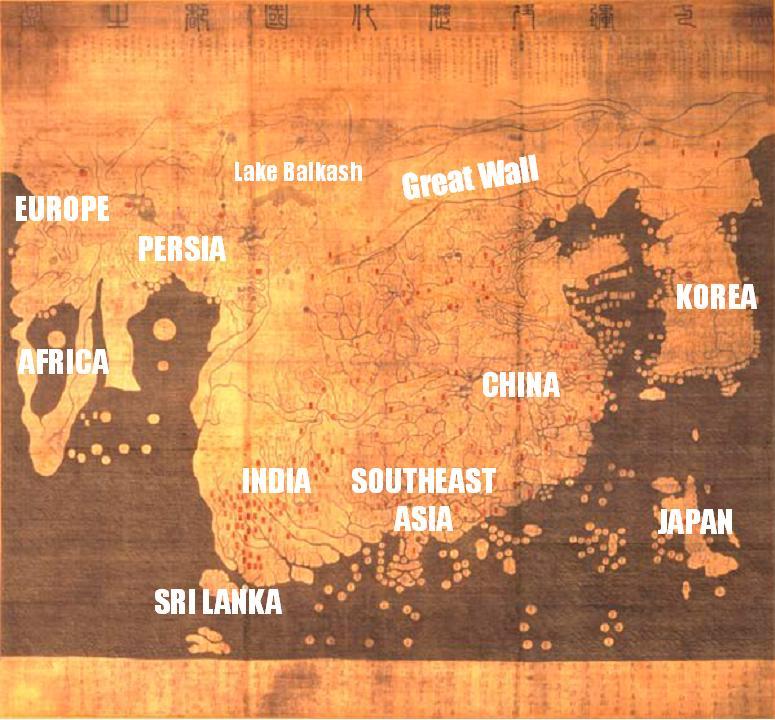
One of the most noteworthy world maps from the period immediately preceding the European discovery of the Americas comes from Korea. Titled Map of Integrated Regions and Terrains and of Historical Countries and Capitals, but known more popularly as the Kangnido, the map was produced in 1402, early in the era of the Yi Dynasty (1392-1910), an age of vigorous cultural renewal for Korea. The cartographers who created this masterpiece borrowed freely from Chinese, Islamic, and Japanese maps to fashion an integrated map that included almost every known area of the world. Once one has become accustomed to the map's eccentricities, the modern viewer is astounded by its perceived appearance of truth. To be sure, Japan is located directly south of Korea and farther away than it actually is. This might well represent a statement of supremacy over an age-old enemy by the Yi court. Also the image of Europe leaves much to be desired, but the fact remains, Europe is on the map!

The Kangnido was copied many times, so prominent was it to the Yi self-image and program of reform and regeneration. Although the original map is now lost, later fifteenth-century copies are in existence. The map that appears at the top dates from around 1470. You can click here for a larger view of the map. Additionally, you can also click here for the same map that has been labeled by scholars, and you can click here for a more detailed breakdown of Europe. After you have studied the maps a bit, I would like you all to think about and discuss the following: What does the relative size of Korea on the map suggest? Where does the center of the map lie? What does that suggest to you? What have the mapmakers done with China, India, and mainland Southeast Asia? What do you infer from this? Locate the Arabian Peninsula and Africa. What strikes you as particularly significant about these two features? In answering this question address their relative sizes and also the shape of Africa. Finally, locate Europe. Which areas are most recognizable? Which are most vague? What do your answers to these two questions suggest about the sources the Korean cartographers used for the Far West? Your thoughts...

Friday, October 17, 2008

A Comparitive Look at the Practice of Foot Binding in Postclassical China

I do realize that we only discussed foot binding in two classes today, but by Monday we'll all have this discussion, and certainly you've all read about the custom in your reading this week. The practice of foot binding is a useful stepping stone to a discussion of the status of women in the Song period especially. Hopefully you all at least understand the “logic” of foot binding-- it is a painful symbol of the constriction of women, and it shelters them from the outside world much the same way as the harem did in the Abbasid empire during the same time period. What does this process say about the changing status of women in China at the time? In your opinion, are there any equivalent societal pressures in the world today? I know you will inevitably want to bring up examples from the Islamic world without examining our own country, but let's focus on this country in 2008. Include specific examples from our own age and country. So, again, are there societal pressures in the world today that we could compare to foot binding in terms of the effects it has on women? Your thoughts...

"The Noble and Magnificent City of Hangzhou": Marco Polo in China

Now that we are beginning to look at the Song Dynasty, let's take a closer look at its capital in the later Song period, Hangzhou (that remained an important city during the Mongol period that we will discuss in great detail later). The Chinese economy grew rapidly during the three centuries from 950 to 1250. There was a great increase in cola mining and in the manufacture of iron tools and weapons. The production of silk and porcelain also expanded. In southern China, the amount of rice harvested shot upward. In addition, major new overseas ports emerged on China's southeast coast. Chinese ships, making use of the mariner's compass (a Chinese invention), began to ply the waters of the South China Sea and the eastern half of the Indian Ocean as never before.

Marco Polo, a Venetian merchant, traveled to China near the end of this great economic boom. Polo, who had journeyed eastward via the overland routes across Central Asia, arrived in China during the 1270s just as the Mongols were completing their long conquest of China. He remained in China for 20 years and traveled widely in the country. During part of this time in China, Polo may have been employed by the Mongols as an official. In the 1290s, Polo decided to return home and chose the maritime route, setting sail from the (then) great Chinese port of Guangzhou (or, Quanzhou).
Scholars have long regarded Marco Polo's book, if used correctly, as an important historical document. Polo's account of his travels, which he dictated to a professional writer shortly after returning home, is a mixture of careful observation, a traveler's tendency to exaggerate (especially in regard to numbers), and fantastic "wonder" stories. In the document that I would like you to read, Polo reports on the city of Hangzhou. You can read excerpts from the document by clicking on the following link (The Travels of Marco Polo). When you are finished reading, please meditate on, and discuss the following: What does Marco Polo report about the size and layout of Hangzhou? How important was commerce in Hangzhou? What evidence do you see of the role of Hangzhou in long-distance trade? What evidence in Marco Polo's report do you see regarding the standard of living of the residents of Hangzhou? What evidence is there that fire was a serious problem in Hangzhou? What provisions were made for detecting and suppressing fires? What evidence is there to suggest that the Hangzhou authorities were worried about the possibility of riot or insurrection? What steps were taken to suppress such occurrences? What does Polo's report suggest about the role of the state in China? Were clocks important in Hangzhou? How did the lives of Hangzhou residents compare with the lives of the peasants in the Chinese poems and legal documents that you read? Are the differences attributable to changes over time or to the quality of urban life as opposed to rural life? How does Marco Polo's report on Hangzhou provide us with evidence regarding the condition of the Chinese economy during the 13th century? In Polo's observations about Hangzhou, is there an implied comparison with western European cities such as his hometown of Venice? How does Polo's report illustrate the importance of cross-cultural contacts during the postclassical era?

Thursday, October 16, 2008

Peasant Life in Tang and Song China: Evidence from Poetry and Legal Documents

Welcome back China! My son returns! As we learn about China during the postclassical period, we will see China in what I refer to as the middle school/high school stage. During the postclassical period most Chinese people, perhaps 85% of the population, were peasants working small plots of land, as had been true for the previous several thousand years. The contributions of the peasants to the country were essential: They grew the grain, bred the animals, made the cloth, mined the coal, built the roads and dug the canals. They also made up the great majority of the soldiers in the army.

What was it like to be a peasant in China during the postclassical period? This basic question has been the focus of much research by scholars during the past several decades. One line of inquiry has studied the material standards of the peasants. How much land did they possess? What techniques did they employ in cultivating the land? How onerous was their tax burden? A second subject of investigation has been the beliefs of the peasants. To what extent did Confucianism, Daoism, and Buddhism shape their thinking? How influential on the peasants was traditional folk religion?

Although the scarcity of documentation regarding the peasants makes it impossible, at least for the present, to fully answer many of these questions, the poems and legal documents that I would like you to read at least give us a good start in our understanding. Most of the poets whose verse appears in this chapter were governmental officials who, in order to obtain their positions, had passed rigorous examinations testing their mastery of Confucian teachings. Some of the officials, notably Dufu, are regarded as among China's greatest poets. Of course, the social origins, rich literary learning, and standard of living of the officials set them apart from the peasants. However, as they moved from posting to posting, the officials had an opportunity to closely observe rural life in many of China's regions and this is reflected in the poems that I would like you to read.

The two legal documents sandwiched between the Tang and Song poems that you are going to read date from the 9th and 10th centuries and were found, together with many similar records, in the western Chinese town of Dunhuang about a hundred years ago. From 400-1000, Dunhuang was one of the most important rest stops for caravans traveling on the Silk Roads to and from China. It was also a huge Buddhist monastic complex, featuring worship centers in about 500 splendidly decorated caves, some of which were also libraries. Around the year 1000 the monks and merchants abandoned Dunhuang, probably because of invasions by nomads from the north. Owing to the extremely arid climate in this region, the contents of the caves--statutes, paintings, and documents of various kinds--were preserved in amazingly good condition until discovered by a British archaeologist in the early 20th century.

Please read the poems and legal documents by clicking on the following link (Tang-Song Poetry). How do the poems and legal records help us to understand the lives of peasants? Additionally, I would like for you all to think about and discuss the following: What do the poems suggest about the material standards of the peasants? How did the peasants provide for their material needs? What did they produce? What kinds of tools did they use? What did Chinese governments require from the peasants? How would you describe the relationship of the peasants to the government? Do the poems provide any evidence of peasant protest? Were the peasants economically self-sufficient? Did they depend on markets? Do the poems suggest that the lives of the peasants were changing over time? Do the poems provide any clues to the beliefs of the peasants? Do you see any indications of Confucianism, Daoism, Buddhism, or folk traditions? What do the poems reveal about the attitudes of Tang and Song officials toward the peasants? Do you see evidence of the officials' Confucian learning? How do the two contracts from Dunhuang add to our understanding of how the peasants lived? What do the contracts suggest about the role of Buddhism in China? What other kinds of evidence would enable us to add to our understanding of the peasants? Finally, in your opinion, do you think Chinese peasants were poorer or better off than peasants elsewhere in the postclassical world?

Tuesday, October 14, 2008

If You Have the Opportunity, Watch FRONTLINE Tonight at 9pm on PBS or Online Anytime

Ladies and Gentlemen, we are now exactly 3 weeks away from a historic election day. As we get closer to elections, you can be sure that the level of propaganda surrounding both candidates will escalate. Unfortunately, it is very difficult to just get pure, unadulterated, good information regarding the presidential candidate's records, policies, and personal life stories, even from major news networks that are supposed to just deliver the news. The good news is that PBS still continues to provide quality programming without the aim of swaying the public in one direction or the other, but instead to provide real information to the viewer, and to give the viewer enough credit to make his or her own informed decision in the end. The PBS program Frontline, in particular, has been providing such information for decades. Tonight, at 9pm, don't miss the Frontline special- The Choice 2008. This special is always fantastic every election year, and tonight's special promises to be particularly good. No mud-slinging, no character assassinations, nothing overly politicized, just the real information about both John McCain and Barack Obama without any of the fluff that you're probably all tired of. This is a historic year that your children and grandchildren will one day study about in school to be sure. With that in mind, please be as informed as possible about both candidates without simply relying on things you hear while out with friends, or on less-than-reliable news programs, or on talk radio. Tonight's episode of Frontline will be a perfect start in helping you to get to know both candidates from a truly balanced perspective. If you were not able to watch it at 9, you can simply watch it online anytime by clicking here. Addtionally, there is a TON of information on both candidates you can research on this site regarding their positions on issues that effect you, as well as their personal histories. This is a GREAT SITE! In closing folks, take the time to get to know the Senators. Feel free to leave your respectful thoughts on the program after watching it on TV or online. By the way, I think the photo above really captures the essense of both candidates better than anything I've seen previously, don't you?

Saturday, October 11, 2008

Africa Through the Eyes of a European Merchant

At the end of our unit regarding Africa and the Indian Ocean I got to thinking that although we have looked at Muslim and other African descriptions of Africa, we have not looked at Africa from a European point of view. It would be wise, therefore, to look at how Africa was viewed by a Europe in the middle of regrouping. Though the Romans had known quite a bit about Africa, even south of the northern rim which they controlled, postclassical Europe had far more limited contacts. In the 15th century, however, expanding trade brought more Europeans to Africa beyond the Mediterranean coast. Their comments, like those of other travelers, help us to learn more about postclassical Africa and of course about the attitudes of Europeans themselves in this period.

Antonius Malfante wrote from Tuat (Tawat) in the central Sahara in 1447, to a colleague in Genoa. Tawat was an important oasis on a trade route from the city-states of northern Nigeria. Malfante obviously traveled fairly widely in the region, and offered interesting comments on the diverse peoples of the area and on the kinds of trading activities they conducted. His observations also cover religious and political issues. We know nothing about Malfante himself. Genoa was increasingly active in Mediterranean trade, so we can surmise that he was involved in these endeavors, as he himself implies.

His account raises the usual questions about traveler's observations, as to which seem particularly accurate, and which are shaded by bias, exaggeration, or unacknowledged ignorance. He was certainly sympathetic in many ways, and in the process may tell us quite a bit about the nature of African civilization in and around the Sahara. I would like you to read some excerpts from Antonius Malfante's writings by clicking on the following link (here) [you only have read pgs. 151-153].

When you are done reading, I would like you to think about and discuss the following: What was Malfante doing in Africa? How was he treated, and how would you explain the way Africans seem to have reacted to him? What aspects of Malfante's observations about Africa seem most surprising to you? Where does he seem to lapse into stereotype or exaggeration? Overall, do you find him a sympathetic observer? What were the main religious features of Saharan Africa and points south? What were the main political features? According to Malfante's account, what kinds of contacts did this African region have with other parts of the world? What was the range and position of African merchants? How does Malfante's account compare with the observations of other commentators on Africa, such as Ibn Battuta? Do his emphases differ? Is he more or less biased? Is this a valuable source for understanding post-classical Africa? What other kinds of sources would help flesh out our grasp of this civilization in this period? Your thoughts...

Are We on the Verge of a GLOBAL Economic Meltdown?

Hello ladies and gentlemen, I hope you all are having a relaxing start to your long weekend. You know, I've been thinking (I know, scary), while we continue to watch the state of the American economy closely and consider its future, it's easy to forget that the United States is not the only country involved in this crisis. In fact, I often find it fascinating to watch the global markets throughout the day periodically, and it's obvious that the entire world is feeling the heat. I hate to make Great Depression comparisons because I hope that we do not sink to that, but it is interesting that we do see a similarity to one thing in particular that occurred in 1929 after the American stock market crashed-- the ripple effect worldwide. If you think that it is only the United States that is watching its economy tank, you have not been watching the world news. There really are three major markets in the world in 2008-- the American market, the European market, and the Asian market. Because all three markets are attached to one another, not only the United States, but also Canada (not in terrible shape comparatively [in fact, Canada was just ranked as the most stable banking system in the world last week. Comparatively, the U.S. was ranked #40, literally behind Namibia!]), Mexico, Argentina, Brazil, Britain, France, Germany, Italy, Spain, the whole EU really, umm... Iceland (yeah, no joke, they're in bad shape there as they find themselves in a bankruptcy situation), Russia, Japan (THEY'RE IN REALLY BAD SHAPE AT THE MOMENT), South Korea, Hong Kong (a separate market from China actually), Australia, Indonesia, India, and China are ALL feeling the burn from this GLOBAL crisis (India and China are not as bad off, but still falling, just not as fast). So what does this all mean? What does the future hold? Ashes, ashes, we all fall down? While nobody seems to know for sure, an ominous forecast was just released by the International Monetary Fund (IMF) today, a global economic agency that was founded after WWII to promote market economies, free trade, and high growth rates (essentially one of the major promoters of global capitalism in the world). The IMF is currently predicting that the world financial system is on the "brink of systematic meltdown." To read the BBC coverage of this major announcement, click here. It's interesting, the debate over communism vs. capitalism has been furious since the late 1800s. In 1991, when the Soviet Union collapsed (and communism along with it), Russia instituted a market system, and the Cold War ended, so many considered this to be the end of economic history as capitalism had finally triumphed over communism. However, fast-forward 17 years to 2008 and it's apparent that the debate clearly continues as the flaws of capitalism are being clearly exposed. So much so in fact, that the United States government, the world leader in capitalist thought and economics, just announced yesterday that it will buy up bank stocks (maybe permanently?) to help settle things down. Just to clarify an economic point here folks, if you are a stock-holder, YOU ARE AN OWNER OF THE COMPANY. Essentially what we're looking at here is the United States considering partial bank ownership (and no small chunk of ownership either). You can read the details on that by clicking here. Is this a reversal of open free market principles? Indeed, the debate continues. The point of this post is this folks, the current economic crisis is not an American issue only, IT IS A GLOBAL ISSUE! As a result of trade that we really saw take off and expand during the post-classical period in the Afro-Eurasian world, and that later expanded even more in later periods, we live in a truly global world in 2008. Especially when it comes to economic issues, no country is an island. Yes ladies and gentlemen, a clear understanding of the unit we just finished is essential, not only to a full understanding of world history, but to a full understanding of the current world, now more than ever in fact. Finally, if you feel a little behind in your understanding of this historic crisis still, click here for the BBC's full coverage of the crisis. There are some EXCELLENT maps and charts on this site to help make the situation much more understandable. Also, click here for an incredible timeline of the crisis dating back to September 14th and goes through yesterday, October 10th. (although I would argue that a timeline for this could date back a few years [2004 perhaps?]). Now your thoughts...

Thursday, October 9, 2008

Tus Preguntas

Hey folks if you have questions regarding tomorrow's test, please feel free to use this area to discuss as usual. Don't be too nervous, most tend to do fairly well on this test as long as they did the week's document assignments and practice working with mapping this evening. But feel free to post here if you need to. Also, if you need another blank map to practice with, you can pull up a blank one by clicking here.

Wednesday, October 8, 2008

Merchants and Trade: Muslim and Christian Perspectives

As has become very obvious in the past few days in class, the postclassical period witnessed an important expansion of trade, within many civilizations and across their fluid boundaries. Merchants gained a growing role in West Africa, throughout the Islamic world, in Europe (both east and west), and in East Asia. Many traded locally, although international merchants made the biggest impression. Chinese commercial centers grew rapidly, supporting a more urban environment. The search for wealth had never been so extensive, the willingness to take risks had never been so great, and the desire to promote commercial interests in government circles had never been so strong. At the same time, many societies had reservations about merchants. Aristocrats worried about their social claims; rulers might envy their wealth; priests and philosophers questioned their motives. The clash of cultures, between religion and materialism, was particularly intense because of the complex new forces at work in these centuries. A genuine ambivalence about merchants was common throughout the postclassical world--and it could affect merchants themselves, as well as how they were treated, and it could also shift. Comparison and assessment of change over time are both essential analytical approaches to the issue of the merchant's role. Christian tradition was uneasy with merchants' motives, fearing that they diverted people from religion. As trade increased, Christian concern relaxed somewhat. But efforts to find ways to accommodate the very different goals of capitalist trade and the holy life continued. Islam was initially more favorable to merchants, whose activities seemed compatible with religious obligations so long as they obeyed basic rules of fairness and gave to charity. It was no accident that Islam had up to that time sponsored the most intense merchant activity known in world history. The Middle East had long been a center of trade, even in the classical period. Muhammad, originally a merchant, praised the life of commerce, so long as it did not violate the primacy of religious goals, and so long as it was accompanied by active chants. But experience introduced greater caution, and toward the end of the postclassical period, as Muslim trade continued, though with slightly less dynamism, ambivalence became more obvious. What value did Muslim thinkers see in trade? What were the danger signals? How do Christian and Muslim views compare at this point?

Given the attitudes and policies suggested for the two societies--Western Europe and the Middle East--which society, in your opinion, was becoming most favorable for merchant activity, and why? Do cultural values really shape trade activities, or is a universal desire for profit more significant? WHAT DO YOU THINK?

The values tensions surrounding merchant activity were very real in the postclassical period in both civilizations. They translated into individual ambiguities. Many European merchants--even some less holy than Godric, whom you are about to read the words of--repented of their goals later in life and gave money away or entered a monastery.

The tensions also reflected a fascinating interaction between economic opportunities and cultural norms. None of the civilizations yielded entirely to one extreme or the other--which is why comparison must be subtle. A search for stark contrasts would be overly simple. The fact that some civilizations changed their balance of power over time adds more complexity. Nevertheless, certain of the differences were real, and they mattered in world history. China, to take the most obvious example, could have played a far larger trade role than it did, but it deliberately held back because of its own internal success (remember, it did not need the outside world) and because of its cultural hostility to trade (Confucian views still hold true there during this period). Europe's growing commercial role required an adjustment of religious concerns, which did prove possible but caused wide anxiety about moral directions.

I would like you to read two documents to solidify the comparisons between Muslim and Christian society regarding trade during the postclassical period. The Muslim description of merchants' vices and merits comes from the great historian and philosopher Ibn Khaldun (our boy is back! This is the same Ibn Khaldun, or course, that was responsible for the 3 Generational Theory), a North African who wrote in the fourteenth century. The description of the twelfth-century British merchant Godric was written by a biographer attracted to his saintly life (most merchants did not, it should be emphasized, become saints). It suggests both actual activities and cultural values. You can read both documents by simply clicking on the link here .

When you have finished reading both documents, I would like for you to read and discuss the following: What kinds of uneasiness did Muslim observers have about trade? How did Islam offer a distinctive combination of trade and cultural goals--a combination relatively favorable to trade without slighting religion? In what ways did Islam and Christianity, such similar religions in many respects, differ over the validity of trade? Would a story like Godric's have been probable in Islam? What exceptions do the sources suggest, even as they emphasize high ideals? What kinds of activities in Europe clearly represented more materialistic motives than those of a holy merchant like Godric? Why, in fact, did Godric not enter a holy calling initially? What kinds of motives drew him to trade? Do the sources demonstrate that Europe was becoming wealthier than the Islamic world by the late postclassical period? In light of the documents you just read, how would you rate the argument that no matter what their professed values, most people and societies are motivated by a desire for profit and will expand commercially whenever they can? In your opinion, is a desire for economic gain an inherent part of human nature? In your opinion, which came first in world history: concern about trade or economic limitations? Did Christianity cause Western Europe's initial commercial lag in the postclassical period, or did economic decline encourage Christian concerns? How did Islam affect actual Middle Eastern economic patterns in the postclassical period? Your thoughts... (I know we haven't gone too deeply into postclassical Europe in here yet, but we will. Consider this a bit of a comparative preview!)